Conventional wisdom says bigger following equals bigger reach. Bigger following equals bigger opportunity. Bigger following equals winning social media. This is 2015 thinking. In 2026, this is completely wrong. Engagement rate matters more than follower count. Engagement rate determines algorithm amplification. Amplification determines reach. Reach determines income. A 10K-follower account with 8% engagement rate outperforms a 100K-follower account with 0.5% engagement rate. Same platform. Different engagement. 100x different outcomes. Algorithms in 2026 are obsessed with engagement rate. Algorithms ignore follower count. This shift happened gradually. Most creators never noticed. Those who noticed are winning. Those who did not notice are stuck.
The Algorithm Shift: From Follower Count to Engagement Rate Obsession
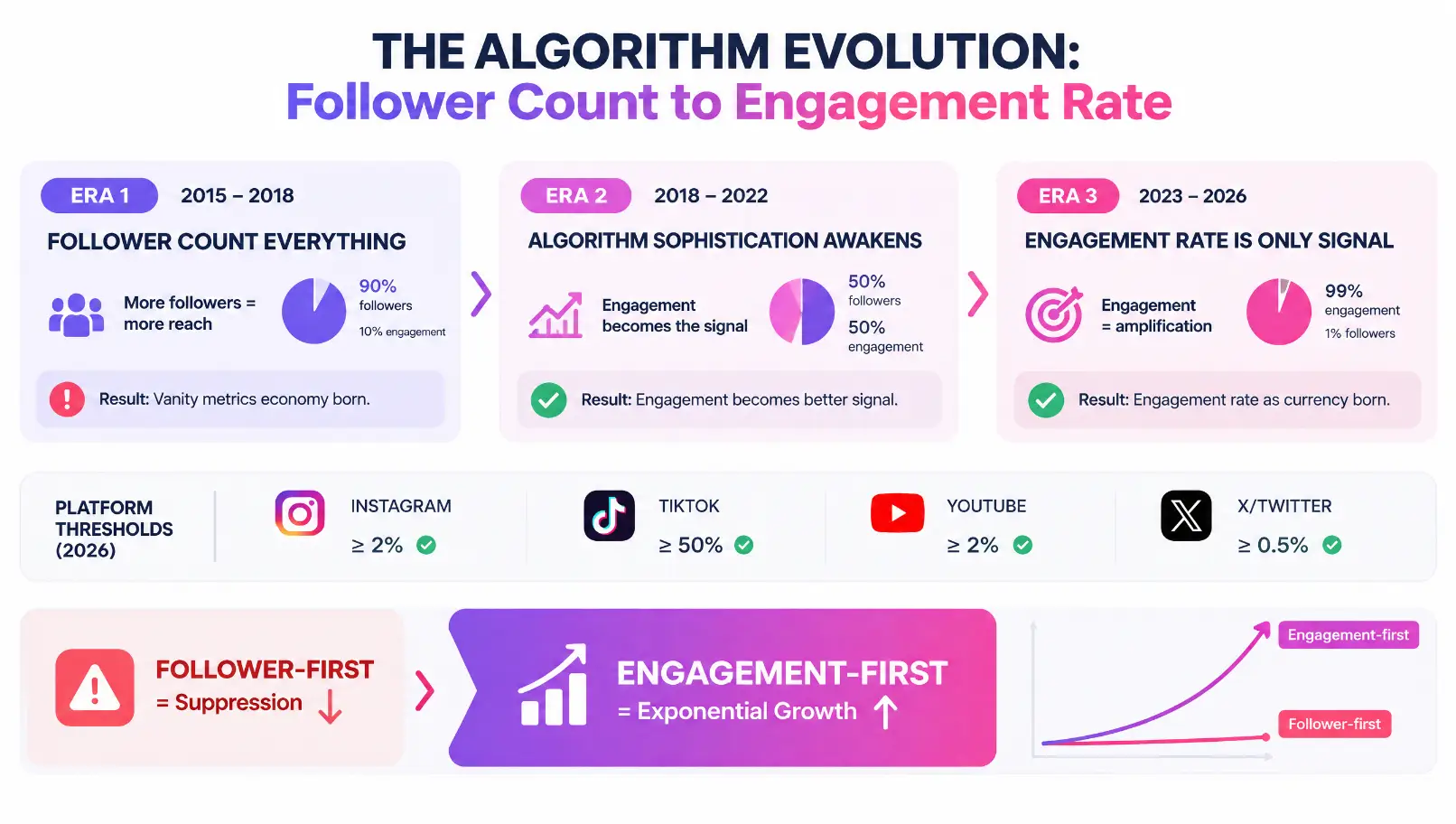
2015-2018: Follower Count Was Everything
Early social media algorithms were simple. More followers = more reach. Reach increased automatically with follower count. Creators competed on follower count. Follower count was status. Followers were currency. Bought followers worked because algorithms did not care about quality. Algorithms only counted numbers. This era created influencer economy based on vanity metrics. 1M followers = influence (whether followers were real or not).
2018-2022: Algorithms Became Sophisticated
Platforms realized follower count was gaming metric. Bots inflated counts. Purchased followers corrupted data. Algorithms needed different signal. Signal needed to be harder to fake. Engagement became that signal. Engagement requires human action. Bots can buy followers. Bots cannot force humans to like posts. Engagement is harder to fake. Algorithms shifted from counting followers to measuring engagement rate. Shift happened slowly (2018-2022). Most creators did not notice shift.
2023-2026: Engagement Rate Is Only Signal That Matters
Modern algorithms in 2026 barely look at follower count. Algorithms look at engagement rate obsessively. High engagement rate = algorithm amplifies. Low engagement rate = algorithm suppresses. Follower count is nearly irrelevant to reach calculation. This is revolutionary shift from 2015 thinking. Creators who understand this shift are winning. Creators still chasing follower count are losing.
Data Finding: The Engagement Rate Multiplier
10K Followers + 8% Engagement Rate vs. 100K Followers + 0.5% Engagement
Account A: 10K followers. Post generates 800 likes (8% engagement rate). Algorithm sees post as high-quality. Algorithm amplifies post. Post reaches 50,000 people organically. Viral potential triggered. 50K reach from 10K followers. Multiplier: 5x.
Account B: 100K followers. Post generates 500 likes (0.5% engagement rate). Algorithm sees post as low-quality. Algorithm suppresses post. Post reaches 5,000 people organically. Suppression activated. 5K reach from 100K followers. Multiplier: 0.05x.
Same content quality (hypothetically). Different engagement rate. 100K-follower account reaches 5,000 people. 10K-follower account reaches 50,000 people. 10x different reach. 10x different opportunity. Engagement rate determines outcome. Follower count does not.
Why Engagement Rate Is Algorithm’s Primary Signal
Engagement Rate Proves Content Quality
Algorithm cannot judge content quality directly. Algorithm cannot watch videos and decide if good. Algorithm can measure engagement. Engagement is human judgment of content. High engagement = humans think content is good. Low engagement = humans think content is bad. Humans are algorithm’s judges. Engagement is verdict. Algorithm trusts engagement signal more than any other metric.
Engagement Rate Proves Audience Loyalty
High follower count + low engagement = audience is not loyal (followers are inactive or fake). High follower count + high engagement = audience is loyal (followers care about content). Algorithm can distinguish between real followers and dead followers by measuring engagement. Algorithm rewards loyalty. Engagement rate is loyalty signal.
Engagement Rate Prevents Algorithm Gaming
Follower count can be purchased. Followers can be faked. Engagement can be purchased but much harder. Engagement requires fake engagement services (and fake engagement is still partially detectable). Algorithm can measure engagement quality (authentic engagement looks different from purchased). Engagement rate is harder to game than follower count. Harder to game = more trustworthy signal. Algorithm prioritizes trustworthy signals.
Platform-Specific Engagement Rate Thresholds (2026 Data)
Instagram Engagement Rate Thresholds
Below 1% engagement: Algorithm suppresses posts. Posts reach only followers (limited amplification). 1-2% engagement: Baseline algorithm treatment. Posts reach followers + some exploration page. 2-5% engagement: Algorithm amplifies. Posts reach followers + significant exploration traffic. Above 5% engagement: High algorithm amplification. Posts reach followers + major viral potential. Instagram algorithm treats 2% as minimum acceptable threshold. Below 2% = suppression activated.
TikTok Engagement Rate Thresholds
Below 30% watch-through: Algorithm suppresses. Videos shown only to follower feed. 30-50% watch-through: Baseline algorithm treatment. Videos shown to For You Page. Above 50% watch-through: Algorithm amplifies. Videos go viral. TikTok’s engagement metric is different (watch-through rate, not likes). But principle is same. High engagement rate = amplification. Low engagement rate = suppression.
YouTube Engagement Rate Thresholds
Below 2% engagement (likes + comments + shares on views): Algorithm suppresses recommendations. Videos shown only in search. 2-5% engagement: Baseline. Videos shown in recommendations. Above 5% engagement: Strong recommendation amplification. Videos reach much larger audiences. YouTube also measures watch time (not just likes). Combined engagement matters (watch time + likes + comments + shares).
X/Twitter Engagement Rate Thresholds
Below 0.5% engagement (likes + retweets + replies on impressions): Algorithm suppresses. Tweets shown only to followers + home timeline. 0.5-2% engagement: Baseline. Tweets shown to broader audience. Above 2% engagement: Algorithm amplifies. Tweets reach trending feeds. X’s threshold is lower (because Twitter/X has different engagement culture). But principle same: high engagement = amplification.
Why Creators Chase Follower Count (And Why This Is Wrong)
Follower Count Is Visible, Engagement Rate Is Not
Follower count appears on profile. Visible = feels important. Engagement rate requires calculation. Not automatically visible = feels less important. Psychology favors visible metrics over invisible ones. Creators optimize for what they see. Follower count is highly visible. Creators optimize for follower count. This optimization is misguided (algorithm does not care about follower count). But psychology drives optimization anyway.
Follower Count Feels Like Status
100K followers sounds impressive. 100K followers = status signal. 8% engagement rate sounds abstract. Abstract metrics do not feel prestigious. Creators want prestige. Follower count provides prestige. Engagement rate does not. So creators chase follower count for psychological reward (prestige). This psychology is mismatch with algorithm reality. Reality is engagement rate determines success. Psychology says follower count determines success. Mismatch creates failure.
Historical Momentum From Follower-Count Era
2015-2020, follower count actually mattered. Habits formed during that era. Creators learned to chase follower count. Habits persist even though algorithm changed. Old habits + new algorithm = wrong strategy. Creators still operating under 2015 rules in 2026 world. World changed. Habits did not.
The Strategic Insight: Focus on Engagement, Not Followers
Optimization for Engagement Rate (Not Follower Count)
Strategy shift: Stop optimizing for follower count. Start optimizing for engagement rate. Stop buying followers. Start buying engagement (likes, comments, shares). Stop measuring success by “how many followers?” Start measuring by “what is engagement rate?” Stop posting for quantity. Start creating for engagement quality. This strategy reversal changes everything. Creators who reverse strategy win. Creators who do not reverse stay stuck.
Engagement-First Content Strategy
Content should be optimized for engagement. What gets engagement? Educational content (6% engagement). Emotional content (5% engagement). Controversial content (7% engagement). Personal content (2% engagement). Strategy: Create content that generates engagement. Do not create content that looks impressive (low engagement). Create content that connects (high engagement). Connection drives engagement. Engagement drives amplification. Amplification drives followers (followers are outcome, not goal). Follower count becomes natural consequence of engagement optimization.
Quality Followers vs. Quantity Followers
10K engaged followers = valuable. 100K dead followers = worthless. Quality over quantity is not new principle. But algorithm enforcement of this principle is new. Algorithm now punishes high-follower-count + low-engagement accounts. Algorithm now rewards low-follower-count + high-engagement accounts. Algorithm enforcement means quality vs. quantity matters more than ever. Strategy implication: Build 10K engaged followers instead of chasing 100K dead followers.
The Hybrid Engagement Strategy: Buy engagement strategically To Build Organic Momentum
Strategic Engagement Purchase (Not Ongoing)
Buy engagement on first 10-20 posts to establish engagement rate pattern. Buy engagement to reach 3-5% engagement rate minimum (algorithm threshold). Once pattern is established, algorithm treats account as high-engagement account. Algorithm begins amplifying organically. Organic engagement kicks in. Stop buying engagement (no longer needed). Organic momentum carries growth forward. This is engagement hybrid strategy. Different from follower hybrid strategy. Engagement strategy is more effective in 2026 environment.
Why Engagement Hybrid Works Better Than Follower Hybrid
Follower hybrid: Bootstrap followers to signal legitimacy. Works but creates dead weight (purchased followers). Engagement hybrid: Bootstrap engagement to signal quality. Works and creates organic momentum (algorithm learns to amplify). Engagement hybrid is superior because it aligns with 2026 algorithm priorities. Algorithm cares about engagement. Algorithm ignores follower count. Strategy that optimizes for engagement priorities wins.
The Data: Accounts Optimizing for Engagement vs. Follower Count
Engagement-First Accounts
Strategy: Post daily with high-engagement content. Buy engagement on first 10 posts. Focus on engagement rate above 3%. Result by month 1: 5K followers, 4% engagement rate. Algorithm treats account as high-quality. Posts reach 5-10x broader audience than follower count would suggest. Month 2-3: Organic engagement accelerates. Growth compounds. Month 3 result: 15K followers, 3-4% engagement rate, self-sustaining organic growth. Total paid investment: £50-100 (engagement boost only). ROI: 15K followers for £100.
Follower-First Accounts
Strategy: Bootstrap 10K followers. Post daily. Hope for engagement. Result by month 1: 10K followers, 0.5% engagement rate. Algorithm sees high followers + low engagement = suspicious account. Algorithm suppresses posts. Posts reach only 500-1,000 people (despite 10K followers). Posts fail engagement test. Suppression continues. Month 2-3: No organic growth (suppression blocks reach). May need to buy more engagement to escape suppression. Total paid investment: £200-500 (followers + ongoing engagement). ROI: Negative (bought followers + suppression = stuck).
Why 2026 Changed Everything
Bot Detection Improved
2026 algorithms can detect fake engagement better than ever. Algorithm can measure engagement quality (authentic engagement looks different from purchased). Algorithm penalizes accounts with high fake-engagement rates. This means low-effort purchased engagement is detected and punished. But strategic engagement (small amounts to establish pattern) still works. Quality-measured detection means bought engagement must be quality.
Influencer Market Matured
2015-2020, anyone with followers could monetize. Follower count = income. Now (2026), influencer market is saturated. Follower count alone does not generate income. Engagement rate generates income. Sponsorship deals are priced on engagement rate (not follower count). Affiliate commissions are based on conversion rate (which correlates with engagement). Ad revenue is based on engagement metrics. Business model shifted from followers → engagement. Creator income depends on engagement now.
Algorithm Sophistication Reached Critical Mass
2026 algorithms are sophisticated enough to measure every signal. Algorithms can weight signals by importance. Engagement rate is weighted 100x more than follower count. Follower count is nearly irrelevant. This weighting creates completely different competitive landscape than 2015. Creators who understand 2026 weighting win. Creators still operating under 2015 assumptions lose.
The Bottom Line: Engagement Rate Is Currency in 2026
Stop counting followers. Start measuring engagement rate. Stop buying followers. Start buying engagement (strategically). Stop optimizing for follower count. Start optimizing for engagement quality. This mindset shift separates winners from losers in 2026. Accounts with high engagement rate win regardless of follower count. Accounts with high follower count + low engagement lose regardless of how many followers.
Complete engagement optimization framework is available in platform-specific engagement strategies. Strategic TikTok engagement services enable creators to establish engagement-rate patterns quickly. Combined with quality content strategy, engagement-first approach achieves superior results compared to follower-count-first approach. Engagement rate matters more than follower count in 2026. Algorithm design proved it. Data confirms it. Success requires believing it.